Vibe Coding in 2026: Benefits, Risks and Limitations
Discover vibe coding in 2026, its benefits, risks, limitations and how AI-powered coding is changing modern software development.

Introduction
Just a few years ago, making an application required mastering a programming language, setting up a development environment, and writing the code line by line during weeks. Now, more and more people describe their ideas with natural language and allow an AI model to write the code for them through AI Development Services. Such an approach has a name – vibe coding.
The word started as a joke in 2025 but it became one of the biggest topics in technology. Vibe coding in 2026 is no longer something a few people try. Startups use it to check ideas in days product managers use it to make working models and skilled engineers use it to avoid repeated work.
Code made this way can be quick and amazing. It can also be weak, not safe and hard to fix later. In this guide we will explain what vibe coding really is, how it functions, which tools people are using and where it has problems. At the end you will have an idea of when it is good, for your company and when it is better to take things slower.
What Is Vibe Coding?
Vibe coding is a modern way to build software with the help of AI. Instead of writing code yourself, you simply tell an AI what you want to create. The AI then generates the code based on your instructions. As a result, you do not need to type every function or worry about fixing syntax errors. You can simply describe your goal in everyday language. For example, you can say, "Build me a booking page with a calendar and email reminders," and the AI can generate an initial version for you.
AI researcher Andrej Karpathy popularized the phrase in 2025. He described vibe coding as a programming style where you "give in to the vibes" and focus less on the code itself. Instead, you review the results, test the application, and ask the AI to make changes. You can also provide feedback and refine the output step by step until the software works as expected.
The Core Idea Behind It
Vibe coding shifts the focus from the technical process of building software to its final purpose and functionality. Instead of writing every line of code, the person directing the process guides the AI, reviews its output and provides feedback to improve the results.
Moreover, vibe coding forms part of the broader movement towards AI-powered software development. However, it differs from traditional AI-assisted coding in one important way. In general AI-assisted software development, developers read and understand every line of code that AI generates. In contrast, vibe coding allows developers to give up some of that detailed understanding in exchange for faster results.
Who Uses Vibe Coding?
Non-technical founders who want to experiment with a product idea and not hire a whole team yet
Designers and marketers who need a fast landing page, tool or dashboard
Professional programmers using it for prototypes, scripts and boilerplate development
Students and hobbyists who want to learn by creating real things quickly
How Does Vibe Coding Work?
If you have ever wondered how Vibe Coding works in practice the answer is simpler than you might expect. Vibe Coding runs on language models that have been trained on huge amounts of public code and documentation. I find this fascinating. These models have learned the patterns of how software's normally written so they can turn a plain description into working code.
Most sessions follow a simple loop.
Step 1: Describe the Goal
You start with a prompt. It might be one sentence or a detailed brief, with screens, features and rules. The better the first result tends to be.
Step 2: The AI Generates the Code
The tool writes the files, picks a framework and often sets up a database or basic styling. Many modern AI coding tools can also run the app instantly so you can see it in a browser.
Step 3: Test and Give Feedback
You click around, try things and see what is not working or is missing. Then you say it in words: "the login button doesn't work" or "make the dashboard load faster."
Step 4: Repeat Until It Feels Right
The AI changes the code based on your feedback. This. Keep going until the app works the way you want. Some tools now work like agents. That means they can read error messages, run tests and fix issues by themselves before giving the result to you.
The main idea is that the conversation takes the place of most of the typing. Your job turns into explaining what you want, checking how things look and guiding the process— of writing every single line of code yourself.
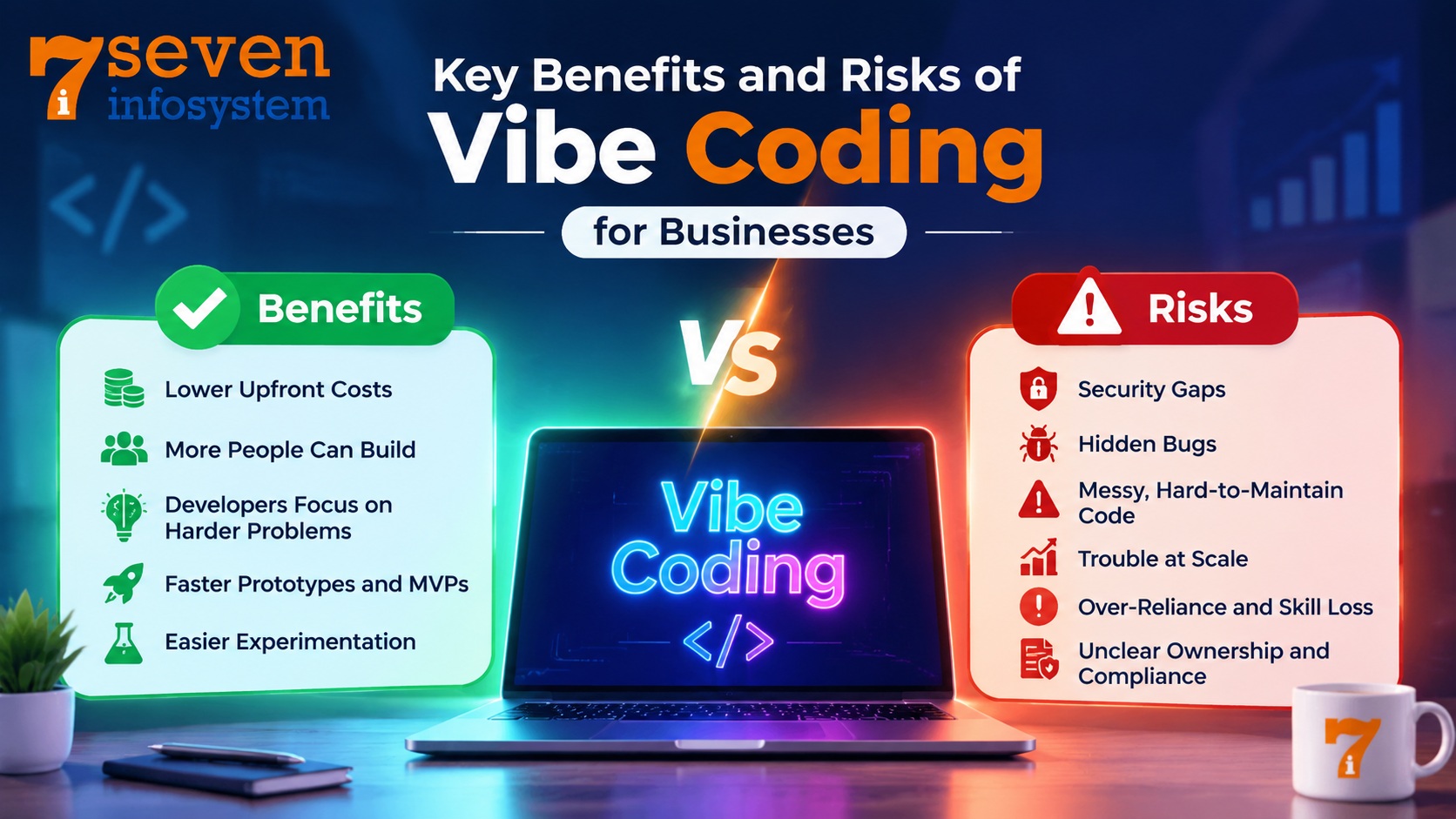
Key Benefits of Vibe Coding for Businesses
The Advantages of Vibe Coding are not limited to the ability to save some time on typing. For many enterprises, this technology transforms the Software Development process by helping teams build applications faster and speed up the testing process.
Lower Upfront Costs
Early startups and small businesses do not have enough budget to hire a whole team for developing software when only the idea is formed. With the help of Vibe Coding, they can validate an idea before investing lots of money.
More People Can Build
Now operations managers, analysts, and marketers themselves are able to develop their own internal tools. The development of a report builder or a minor inventory system does not have to be added to the engineering pipeline for weeks.
Developers Focus on Harder Problems
Seasoned developers can delegate the mundane tasks such as the creation of the forms, generating of test data, and developing of minor administration pages. This way they will be able to pay attention to the architecture, performance and complex business logic which is too complicated for an AI.
Faster Prototypes and MVPs
Instead of waiting for a month to create a fully functional prototype, businesses can use Web Development Services to turn their ideas into working digital products within a shorter time. It gives enterprises the opportunity to present their product to their clients and potential investors without the help of PowerPoint presentations.
Easier Experimentation
Due to the cheapness and quickness of the development, teams are able to try several variants of one feature and choose the most successful for users.
Using AI software development for the appropriate tasks enables businesses to go faster without increasing team size at each step.
Risks and Limitations of Vibe Coding
Being fast is amazing, yet there is a price to pay for that. The Knowledge of Risks of Vibe Coding is no less critical than the knowledge of its benefits in case your app is planned to be presented to real users.
Security Gaps
Models create secure code, but sometimes this code can turn out to be insecure. Such risks include unprotected passwords or API keys, poor authentication mechanisms, and publicly accessible databases. The lack of human review allows these security issues to become visible only after some trouble has happened.
Hidden Bugs
Your application may seem to work perfectly during the brief testing session, yet it can crash unexpectedly on the side of the user. It happens because the coder who controls the process doesn't understand what is going on under the hood.
Messy, Hard-to-Maintain Code
Typically, AI approaches problem solving by tackling each request separately, thus resulting in duplicates and weird workarounds in the course of multiple cycles of development. This situation is generally known as technical debt, and it complicates any future change even more.
Trouble at Scale
One of the major drawbacks of Vibe Coding is that the method is only suitable for small and concise projects. A large system with lots of users, data, and other requirements needs proper planning and Enterprise Software Development to ensure scalability, security, and long-term performance.
Over-Reliance and Skill Loss
Junior programmers that rely excessively on AI assistance might miss out on the essential learning process of the basics. In case the machine gets stuck, they will have problems with further development.
Unclear Ownership and Compliance
In the regulated industries such as finance or healthcare, a business should provide the detailed description of its software capabilities with regard to data handling. It becomes really hard when nobody on the team knows what the piece of code does.
None of these issues should stop you from vibe coding. It just means that human intervention and tests are still necessary.
Popular AI Coding Tools in 2026
The development of the AI Development Tools market has been rapid, leading to a division of products into three main categories. The choice of the Best AI Tools for Vibe Coding will depend entirely on your coding comfort level and what you are looking to develop.
AI-Powered Code Editors
They look like typical code editors but integrate AI into the entire development process. These tools will be suitable for people who want to see and manage the code.
Cursor: One of the widely used AI editors. It understands your project and can make changes across many files from a single request.
Windsurf: A similar editor that focuses on keeping track of context as you work, with a generous free plan.
GitHub Copilot: Works inside popular editors like VS Code and has grown from simple autocomplete into a full assistant that can handle larger tasks.
Terminal-Based Coding Agents
These agents work through the command line interface. They are easy to use in reading, editing, and testing the entire codebase without much assistance. Such coding agents are used mostly by seasoned programmers.
Claude Code: Anthropic’s agent, famous for performing large complex multi-step operations within a project.
OpenAI Codex: OpenAI’s coding agent that writes, reviews, and fixes code from the terminal and the cloud.
Gemini CLI: Coding agent by Google famous for its free tier.
Browser-Based App Builders
This class of software provides the easiest way to create your application without installation. Describe your application using a chat interface and get the result in real time.
Lovable: It builds web applications using prompts and is very popular among founders and designers.
Bolt.new: It creates and runs full-stack applications right from the browser.
Replit: This platform integrates an online editor, an AI agent, and the capability to host the app.
v0 by Vercel: It specializes in creating the UI of your application according to the description provided.
Almost all the AI Software Development Tools described above provide free tiers, hence trying a couple of them should be worthwhile.
Vibe Coding vs Traditional Coding
The debate around Vibe Coding vs Traditional Coding isn't really about which one wins. Each approach fits different situations, and many teams now mix both.
Factor | Vibe Coding | Traditional Coding |
Speed to first version | Hours or days | Weeks or months |
Skill needed to start | Low; clear communication matters most | High; needs programming knowledge |
Control over the code | Limited, since the AI makes many choices | Full control over every decision |
Code quality | Varies and often needs cleanup | Usually consistent when standards are followed |
Security | Depends heavily on review | Built in through planning and reviews |
Best suited for | Prototypes, MVPs, internal tools | Large, long-term, high-risk systems |
Where Vibe Coding Shines
It is a choice when speed is more important than perfection. Trying out a business idea, creating a special data tool or building a sample for a customer are all good examples.
Where Traditional Coding Still Leads
Projects that deal with money transactions, health information or large numbers of users require preparation. In these cases people who plan the structure and know every part of the code are still very important.
In reality the difference between the two is becoming less clear. Many programmers write the sections themselves and let artificial intelligence take care of the simple parts.
Is Vibe Coding Suitable for Professional Software Development?
The honest answer is: partly. Vibe coding can play a useful role in professional work, but it shouldn't run unchecked on its own.
Professional teams found a reasonable compromise. They use AI to speed things up, while still applying all usual practices to the generated code. In other words, vibes help with getting started, while discipline helps with getting results.
How Professional Teams Use It Safely
Write and run tests. Automated tests catch bugs that a quick visual check misses, making Software Testing and Quality Assurance essential for reliable applications.
Review every change. Treat AI output like code from a new team member: helpful, but not trusted until it's checked.
Scan for security issues. Use security tools to detect any secrets leaked, too permissive access permissions, and outdated libraries.
Keep humans in charge of design. Let people choose the architecture, data model, and business logic.
Document as you go. Ask the AI to explain all changes done.
Once these practices become a habit, vibe coding will be a useful tool. Otherwise, it may lead to problems that cost significantly more to solve than time savings.
The Future of AI-Assisted Software Development
The Future of Software Development looks like humans versus machines and more like humans working alongside them. A few clear trends are already taking shape.
Smarter, More Independent Agents
AI tools are moving from answering requests to handling whole tasks. Agents can now plan a feature, write the code, run tests and fix their mistakes. Over time they'll likely take on chunks of work with less supervision.
Better Built-In Safety Checks
As awareness of the dangers increases, software tool developers will begin incorporating automatic safety checks such as security audits, code review, and other quality measures.
A Changing Role for Developers
Skills like system design, problem framing, code review, and clear communication will matter more than memorizing syntax, especially when developing applications through Mobile App Development. The most valuable engineers will be those who know how to guide AI well and spot when it's wrong.
Wider Access to Software Creation
The Future of Vibe Coding shows a world where almost anyone can build a tool. Small businesses, teachers and nonprofits will be able to create software that fits their needs without big budgets.
Still one thing is unlikely to change. Someone has to take responsibility for what the software does. That someone will be human.
Conclusion
Vibe coding has made software development faster and more accessible, especially for businesses that need cost-effective solutions. For example, developers can now build prototypes in less time and test new ideas quickly. As a result, they can focus more on complex tasks that require human expertise and decision-making.
However, vibe coding does not solve every development challenge. AI-generated code can contain security vulnerabilities, hidden bugs, and maintenance issues, especially when developers do not review it carefully. Therefore, businesses should use vibe coding for suitable tasks while involving professional developers in critical processes.
Think of AI as an efficient assistant, not a replacement for human decisions. By combining AI-powered tools with professional expertise, your company can make the most of vibe coding while maintaining code quality, security, and long-term reliability.
FAQs
1. Is vibe coding good for beginners?
Yes, it's a great way to start building quickly. Learning basic programming alongside it will help you fix problems the AI can't solve.
2. Can vibe coding replace software developers?
No. It speeds up many tasks, but complex systems still need developers to design, review, and maintain the code.
3. Is code created through vibe coding secure?
Not automatically. Always review, test, and scan AI-generated code before using it with real users or sensitive data.
4. What can I build with vibe coding?
It works well for prototypes, MVPs, landing pages, simple web apps, and internal business tools.
5. Do I need to pay for vibe coding tools?
Most popular tools offer free plans for testing. Paid plans usually unlock more usage, better models, and team features.